
A Practical Introduction to Physics: Concrete Planning for Effective Learning and Exploration
Explore how to effectively plan your journey into physics through practical steps, targeted study areas, and hands-on experiments tailored for science education and exploration.
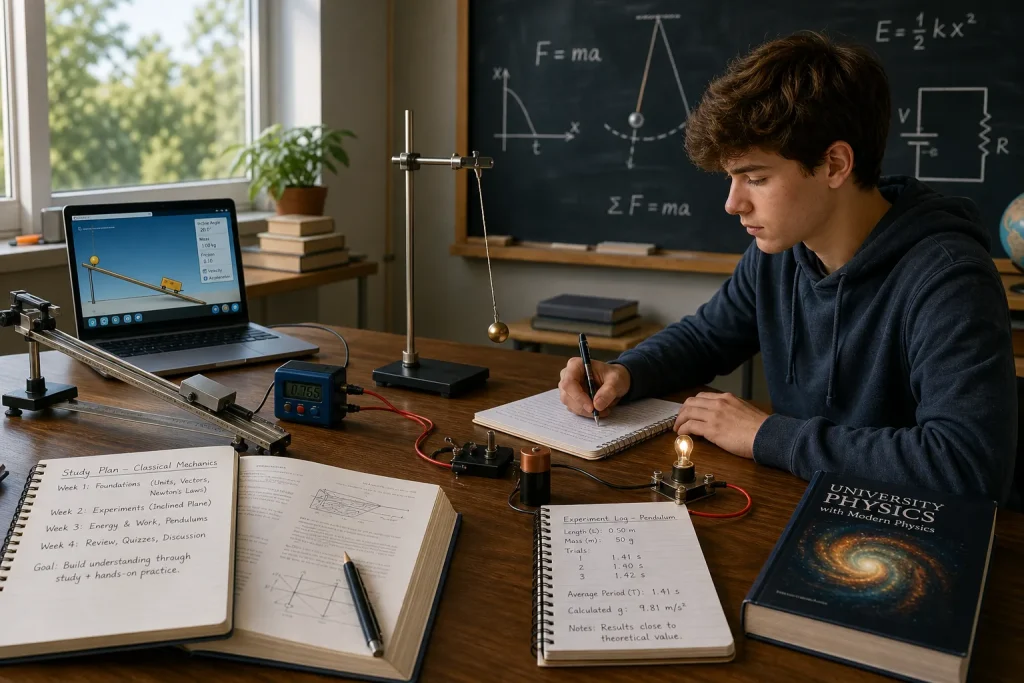
Physics is a foundational science that explains the fundamental forces and laws of nature, impacting every aspect of our daily lives and the universe. For anyone passionate about science education and exploration, starting with physics offers practical insights and skills applicable across disciplines. However, diving into physics without a clear plan can be overwhelming due to its breadth and depth. This article provides a concrete introduction with actionable planning decisions to help learners structure their study, choose relevant topics, and engage in meaningful experiments to build a strong understanding of physics principles.
Understanding Your Learning Objectives
Before beginning your physics journey, clarify why you want to learn the subject. Are you a student aiming to improve your school grades, a hobbyist exploring scientific curiosity, or a future educator preparing teaching materials? Your objectives influence the choice of topics and learning methods. For example, students preparing for exams might focus on standard curricula and problem-solving techniques, while enthusiasts might prioritize conceptual understanding and experimentation.
Identifying objectives helps prioritize effort and resources effectively. It permits setting realistic short-term and long-term goals, such as mastering classical mechanics first before tackling electromagnetic theory. Clear objectives also assist in choosing appropriate reference materials, courses, and projects, preventing frustration caused by trying to learn too broadly or at an unsuitable difficulty level.
Selecting Key Physics Topics to Study
Physics encompasses several core fields, including mechanics, thermodynamics, electromagnetism, optics, and modern physics like relativity and quantum mechanics. For practical learning, start with classical mechanics, which deals with motion, forces, and energy—concepts intuitive and observable in everyday life. This foundation supports understanding more advanced fields later.
After mechanics, incorporating topics like electricity and magnetism enables exploration of phenomena such as circuits and magnets. Thermodynamics introduces energy transfer and states of matter, which bridge physics and chemistry. Prioritize topics based on your objectives, balancing theory with practical applications and experiments that reinforce understanding.
Planning Hands-On Experiments and Activities
Physics concepts become much clearer through direct experience. Planning experiments relevant to your chosen topics reinforces learning. For classical mechanics, start with simple activities like measuring acceleration using inclined planes, or experimenting with pendulums to understand harmonic motion. These experiments require basic materials easily available or improvable at home or school.
Progress to electrical circuit experiments, such as building simple circuits with batteries, wires, bulbs, and switches. Engaging in these projects fosters intuition about how current flows and voltage works. Documenting observations and comparing results with theoretical predictions develops critical scientific skills, including analysis and problem-solving.
Utilizing Educational Resources and Tools
Choose educational resources that match your learning style. Textbooks offer structured content and problems, while online platforms provide interactive simulations and videos catering to diverse preferences. For example, simulation tools like PhET allow virtual experimentation without physical materials, particularly helpful when access to labs is limited.
Additionally, joining science clubs, forums, or study groups offers opportunities to discuss concepts, ask questions, and share discoveries. Peer interaction encourages motivation and exposes learners to diverse perspectives and problem-solving approaches. Libraries, open courseware, and science museums also furnish valuable supplementary materials.
Monitoring Progress and Adapting Your Plan
Effective learning requires regular assessment of understanding and adapting accordingly. Maintain a study journal or log to track topics covered, experiments conducted, difficulties encountered, and concepts mastered. Self-testing with quizzes or practice problems highlights areas needing reinforcement.
Be flexible with your plan. If a topic proves particularly challenging, allocate additional time or seek alternative explanations. Likewise, if you master material rapidly, accelerate your schedule or explore advanced topics. This dynamic approach ensures steady progress and sustained engagement.
Example: Planning a Month-Long Introduction to Classical Mechanics
Starting Situation: A high school student with basic algebra knowledge wants to learn classical mechanics over one month to enhance their grasp of physics for school and personal interest.
Plan:
- Week 1: Study foundational concepts such as units, scalar and vector quantities, and Newton’s laws of motion using chapters from a high school physics textbook.
- Week 2: Conduct simple experiments measuring acceleration on an inclined plane and analyze results.
- Week 3: Focus on energy and work, investigate pendulum motion experimentally, and solve related problems.
- Week 4: Review learning using online quizzes, virtual simulations of mechanical systems, and consolidate understanding by discussing with a teacher or study group.
Expected Result: The student gains practical understanding of mechanics through both study and experimentation, builds confidence with problem-solving, and develops curiosity to explore further physics topics.
Conclusion
A practical introduction to physics benefits greatly from concrete planning, balancing theory with hands-on experience, and adapting to personal goals. By defining clear objectives, selecting relevant topics, engaging in experiments, utilizing varied resources, and monitoring progress, learners build a robust foundation in physics. This systematic approach not only demystifies complex concepts but also nurtures scientific thinking essential for science education and exploration. Embarking on your physics journey with a well-structured plan transforms learning into an exciting, manageable, and deeply rewarding endeavor.